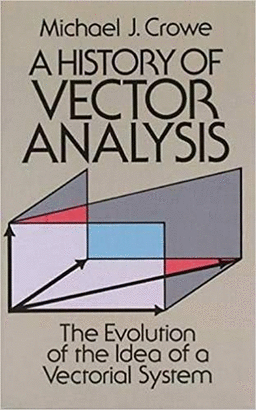
El 16 de octubre de 1843, Sir William Rowan Hamilton descubrió los cuaterniones y, el mismo día, presentó su avance a la Real Academia Irlandesa. Mientras tanto, en un estilo menos dramático, un profesor de secundaria alemán, Hermann Grassmann, estaba desarrollando otro sistema vectorial que involucraba números hipercomplejos comparables a los cuaterniones. Las creaciones de estos dos matemáticos condujeron a otros sistemas vectoriales, especialmente el sistema de análisis vectorial formulado por Josiah Willard Gibbs y Oliver Heaviside y ahora casi universalmente empleado en matemáticas, física e ingeniería. Sin embargo, el sistema Gibbs-Heaviside ganó aceptación solo después de décadas de debate y controversia en la segunda mitad del siglo XIX respecto de cuál de los sistemas competidores ofrecía las mayores ventajas para la pedagogía y la práctica matemática.
Este volumen, el primer estudio a gran escala del desarrollo de sistemas vectoriales, traza el surgimiento del concepto vectorial desde el descubrimiento de números complejos a través de los sistemas de números hipercomplejos creados por Hamilton y Grassmann hasta la aceptación final alrededor de 1910 del sistema moderno. de análisis vectorial. El profesor Michael J. Crowe (Universidad de Notre Dame) analiza cada sistema vectorial principal, así como las motivaciones que llevaron a su creación, desarrollo y aceptación o rechazo.
El enfoque vectorial revolucionó los métodos matemáticos y la enseñanza en álgebra, geometría y ciencias físicas. Como explica el profesor Crowe, en estas áreas los métodos cartesianos tradicionales fueron reemplazados por enfoques vectoriales. También presenta la historia de las ideas de suma, resta, multiplicación, división de vectores (en aquellos sistemas donde ocurre) y diferenciación. Su libro también contiene retratos refrescantes de las personalidades involucradas en la competencia entre los diversos sistemas.
Los maestros, estudiantes y practicantes de matemática, física e ingeniería, así como cualquier persona interesada en la historia de las ideas científicas, encontrarán que este volumen está bien escrito, bien argumentado y excelentemente documentado. Los revisores lo han descrito como "un volumen fascinante", "un estudio histórico atractivo y penetrante" y "un libro sobresaliente (que) sin duda seguirá siendo el trabajo estándar sobre el tema". En 1992 ganó un premio a la excelencia de la Fundación Jean Scott de Francia.
On October 16, 1843, Sir William Rowan Hamilton discovered quaternions and, on the very same day, presented his breakthrough to the Royal Irish Academy. Meanwhile, in a less dramatic style, a German high school teacher, Hermann Grassmann, was developing another vectorial system involving hypercomplex numbers comparable to quaternions. The creations of these two mathematicians led to other vectorial systems, most notably the system of vector analysis formulated by Josiah Willard Gibbs and Oliver Heaviside and now almost universally employed in mathematics, physics and engineering. Yet the Gibbs-Heaviside system won acceptance only after decades of debate and controversy in the latter half of the nineteenth century concerning which of the competing systems offered the greatest advantages for mathematical pedagogy and practice.
This volume, the first large-scale study of the development of vectorial systems, traces he rise of the vector concept from the discovery of complex numbers through the systems of hypercomplex numbers created by Hamilton and Grassmann to the final acceptance around 1910 of the modern system of vector analysis. Professor Michael J. Crowe (University of Notre Dame) discusses each major vectorial system as well as the motivations that led to their creation, development, and acceptance or rejection.
The vectorial approach revolutionized mathematical methods and teaching in algebra, geometry, and physical science. As Professor Crowe explains, in these areas traditional Cartesian methods were replaced by vectorial approaches. He also presents the history of ideas of vector addition, subtraction, multiplication, division (in those systems where it occurs) and differentiation. His book also contains refreshing portraits of the personalities involved in the competition among the various systems.
Teachers, students, and practitioners of mathematics, physics, and engineering as well as anyone interested in the history of scientific ideas will find this volume to be well written, solidly argued, and excellently documented. Reviewers have described it a s "a fascinating volume," "an engaging and penetrating historical study" and "an outstanding book (that) will doubtless long remain the standard work on the subject." In 1992 it won an award for excellence from the Jean Scott Foundation of France.